
astronomy.de
Astrophotography by H.Dannhoff
Supernovae
Latest SN-Data: Bright Supernova
Far developed stars are changed or completely destroyed by disastrous explosions. Supernovae develop extreme brightnesses for one whole galaxy like M33 comparably.


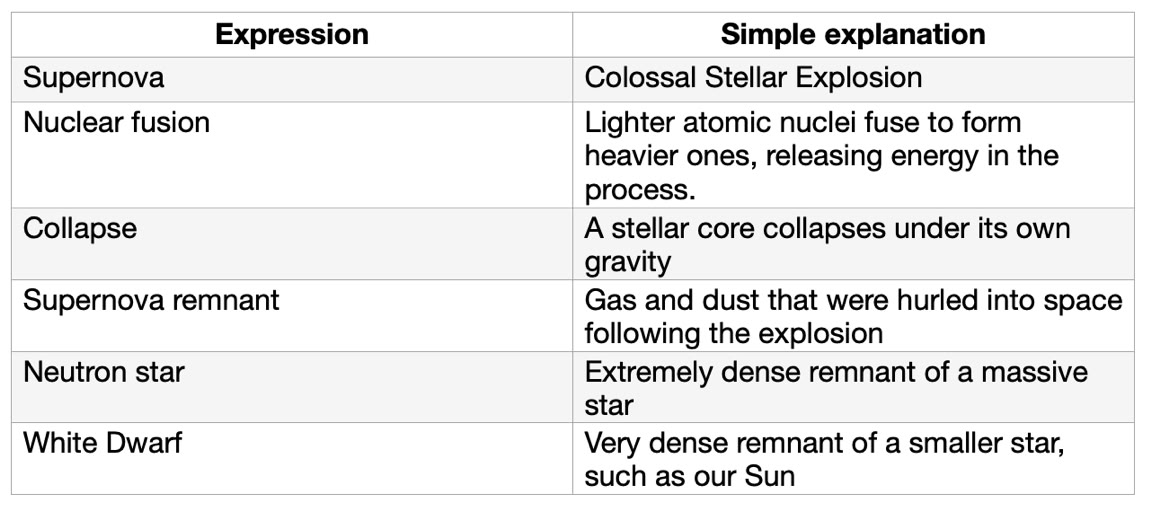
Supernovae – Explained Simply and Clearly
A supernova is a massive stellar explosion. In a very short amount of time, an incredible quantity of energy is released. This can cause a star to shine so brightly that it becomes visible from a great distance.
Supernovae are among the most energetic events in the universe. They also play a crucial role in the formation of new stars, planets, and even the chemical elements that make up our own existence.
1. How does a supernova occur?
Not every star explodes in the same way. There are two primary types, which arise through different processes.
Type 1: A massive star explodes at the end of its life
Step 1: The star consumes its fuel
Inside a star, temperatures and pressures are extremely high. Atomic nuclei fuse together—a process known as nuclear fusion.
This generates energy, which keeps the star hot and exerts an outward pressure.
Step 2: Iron forms in the core
In very massive stars, increasingly heavy elements are created over the course of the star's life. Eventually, iron may accumulate in the core. The fusion of iron does not produce the energy required to keep the star stable.
Step 3: The core collapses
Gravity gains the upper hand. The core collapses in a fraction of a second, resulting in extreme compression. This triggers a shock wave that can propel the star’s outer layers out into space.
Step 4: The supernova
The outer layers are hurled into space at high speed, leaving behind an expanding nebula of gas and dust. At the center, a neutron star or a black hole may form.
Important: Not every massive star ends in a visible, full-scale supernova. Some collapse so completely that a black hole is formed, while the explosion itself is either very weak or fails to occur altogether.
Type 2: A white dwarf triggers an explosion
A second important type of supernova occurs in a binary star system, in which two stars orbit each other.
1. One of the stars has already become a white dwarf. The extremely dense remnant of a former star.
2. A white dwarf can accrete matter from a companion star or merge with another white dwarf.
3. Under the right conditions, an uncontrolled nuclear reaction is triggered.
4. The white dwarf is torn apart in a massive thermonuclear explosion.
Unlike the first type, a typical supernova of this kind leaves no neutron star behind.
2. What remains after a supernova?
This depends on the type of explosion and the mass of the original star.
- A cloud of gas and dust: The ejected material spreads out through space over thousands of years or longer. Such remnants are called supernova remnants.
- A neutron star: The extremely dense core of a massive star may remain. A tiny volume can contain more mass than the Sun.
A black hole: If the collapsing core is massive enough, its gravity can become so intense that a black hole is formed.
3. Why are supernovae so important?
Supernovae are more than just spectacular explosions; they contribute to the diversity of the universe as we know it.
They distribute chemical elements. Stellar explosions propel elements—such as oxygen, silicon, and iron out into space. Some particularly heavy elements are created during specific supernova processes, while others such as a large portion of the gold that exists—are primarily formed when neutron stars merge.
They contribute to the formation of new stars. The ejected material mixes with the gas present in space. Shock waves can compress gas clouds, potentially triggering the birth of new stars under the right conditions.
They provide insights into the universe. Certain types of supernovae, specifically Type Ia, help astronomers determine the distances to remote galaxies and study the expansion of the universe.
4. How bright is a supernova?
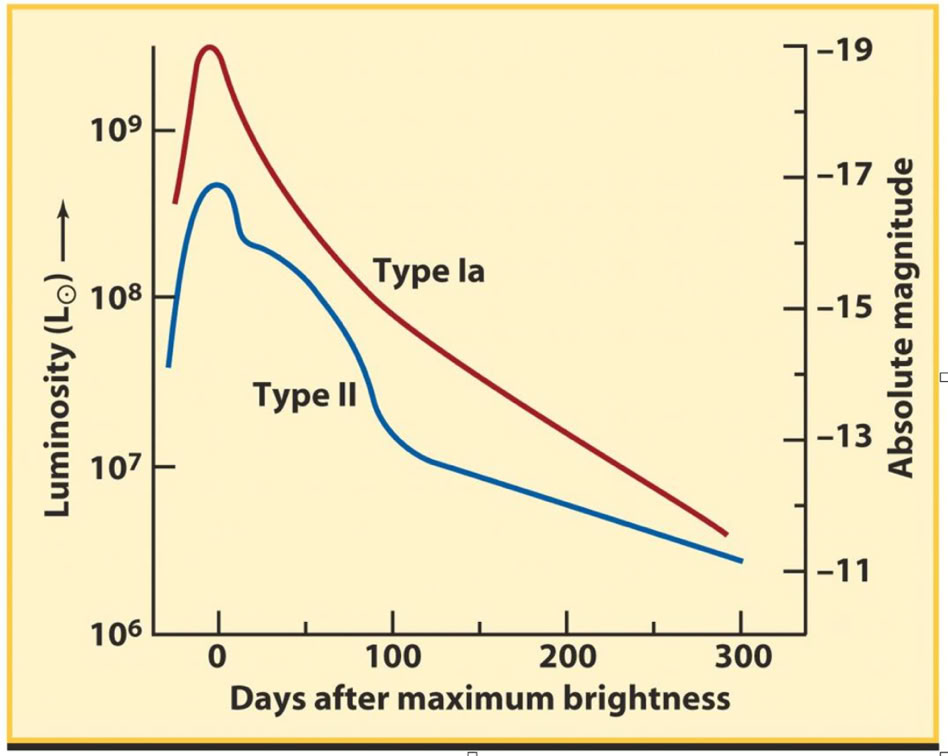
At times, a supernova can shine as brightly as billions of stars combined. Its luminosity can equal or even exceed that of an entire galaxy, even though the light originates from just a single exploding star.
However, not all supernovae have the same brightness. The actual luminosity depends on factors such as the type of explosion and the amount of radioactive material ejected.
5. Will our Sun explode, too?
No. Our Sun does not have enough mass.
In about five billion years, the hydrogen in its core will be largely exhausted. It will expand into a red giant and subsequently shed its outer layers. What will remain is a white dwarf. It is not expected that our Sun will ever become a supernova.
6. Key points at a glance
Key point: A supernova is the explosive end of certain stars. It hurls matter into space, can leave behind a neutron star or a black hole, and helps distribute the building blocks for new stars, planets, and life throughout the universe.
Type I and Type II Supernovae: What Is the Difference?
The primary difference is this: In a Type Ia supernova, a white dwarf explodes due to a thermonuclear reaction. In a Type II supernova, the core of a massive star collapses, which can trigger an explosion.
Both events release enormous amounts of energy, but the processes occurring internally are entirely different.
Type Ia
Explosion of a white dwarf
The star is torn apart by an uncontrolled nuclear reaction.
Type II
Collapse of a massive star
The core collapses; the outer layers are ejected.
A brief clarification of terms: The classification into Type I and Type II originally stems from the observed light spectrum—specifically, the lines left in the light by certain chemical elements. Type I supernovae show no hydrogen lines, whereas Type II supernovae do. A Type Ia supernova is a specific subcategory of Type I; it is not synonymous with all Type I supernovae.
Type Ia: The thermonuclear explosion
What happens before the explosion?
Step 1: A white dwarf is formed
A star that lacks sufficient mass to undergo a core-collapse supernova may leave behind a white dwarf at the end of its life. This remnant consists primarily of carbon and oxygen and is extremely dense.
Step 2: It acquires additional matter
In a binary star system, a white dwarf can accrete gas from its companion star. Alternatively, two white dwarfs may merge. However, not every such system results in a supernova.
Step 3: A nuclear reaction spirals out of control
Under the right conditions, carbon and oxygen are heated and compressed to such an extent that nuclear fusion begins explosively. This releases a vast amount of energy in a very short span of time.
Step 4: The white dwarf is torn apart
The thermonuclear reaction releases so much energy that it tears the entire star apart, hurling its matter out into space. In a typical Type Ia supernova, no compact stellar core remains.
Why can the reaction escalate so suddenly?
A white dwarf is supported against gravity primarily by what is known as electron degeneracy pressure. This arises from the quantum mechanical properties of electrons and functions differently than standard gas pressure.
When a nuclear reaction heats up a white dwarf, it does not initially expand as effectively as an ordinary gas would. Consequently, the temperature can continue to rise, causing nuclear fusion to accelerate even further. The reaction becomes self-reinforcing until the star is torn apart.
In this process, the mass of a white dwarf is often close to the Chandrasekhar limit approximately 1.4 solar masses. However, this specific mass is not a strict requirement for every Type Ia supernova; other explosion scenarios, such as the merger of two white dwarfs, are also being studied.
Type II: The collapse of the stellar core
What happens before the explosion?
A Type II supernova occurs at the end of the life of a massive star. Such stars typically begin with at least about eight solar masses, though the exact threshold depends on the star's specific evolutionary path.
Step 1: The star becomes a red supergiant
Over the course of its life, the star fuses hydrogen into helium and, later, through several developmental phases, into other elements. It expands significantly, potentially becoming a massive red supergiant. Its outer layers typically still contain a large amount of hydrogen.
Step 2: Distinct layers form in the interior
Inside the star, layers consisting of different elements, such as helium, carbon, oxygen, silicon, and finally iron, form in succession. This is similar to the layers of an onion.
In very massive stars, this process occurs much more rapidly than it does in the Sun.
Step 3: The iron core collapses
Iron fusion does not produce the energy required to keep the star stable. If the iron core becomes too massive, it can no longer withstand the pressure of its own gravity.
Furthermore, high-energy photons can break apart iron nuclei, and electrons can react with protons to form neutrons. Both processes deplete the core of the energy, or pressure, that keeps it stable. Consequently, the core collapses violently in less than a second.
Step 4: An extremely dense core is formed
The inner core becomes so dense that the matter can hardly be compressed any further. Typically, a hot, newly formed neutron star emerges. A shock wave travels outward, though it often stalls initially.
Step 5: The explosion ejects the outer layers
Enormous quantities of neutrinos are released during the collapse. A small fraction of their energy is transferred to the material behind the shock wave, which can help to re-energize it.
If this occurs, the star’s outer layers are hurled into space, and the star flares up as a supernova. What remains is a neutron star—or, under the right conditions, a black hole.
Why does a star explode when its core collapses?
At first, this seems contradictory: the core falls inward, yet the star ejects its outer layers outward.
The crucial point is that a vast amount of gravitational energy is released during the collapse. A large portion of this energy is converted into neutrinos. While these particles typically pass through matter with great ease, a small fraction of their energy is deposited into the material surrounding the core, which can revive a stalled shock wave.
The precise mechanisms are complex. Not every core collapse results in a successful explosion; factors such as the star’s mass, structure, and rotation all play a role.
What happens after the explosion?
Differences persist even after the moment of the explosion itself.
Type Ia
The ejected material contains a large amount of radioactive nickel-56. This decays first into cobalt-56 and subsequently into iron-56. The energy released during this process keeps the supernova remnant bright for a period of time. Consequently, Type Ia supernovae often exhibit similar light curves (patterns of brightness over time).
Type II
In this case, the remaining hydrogen envelope significantly influences the light curve. In many Type II-P supernovae, the brightness remains relatively constant for weeks as the ejected layers expand and cool. Other Type II supernovae show a more steady decline in brightness..
Why are they called Type I and Type II in the first place?
These names originated before the processes occurring inside stars were well understood. Astronomers studied the light from these explosions and discovered differences in their spectra:
Type I: No hydrogen lines in the spectrum.
Type II: Hydrogen lines are present.
It was later discovered that Type Ia supernovae are caused by the thermonuclear explosion of a white dwarf, while Type II supernovae are triggered by the core collapse of a massive star.
However, there is an important nuance: core-collapse supernovae can also lose their hydrogen before exploding. These are then classified as Type Ib or Type Ic. Consequently, the category of core-collapse supernovae is broader than just Type II.
A simple analogy to help you remember
Imagine two different types of catastrophes:
Type Ia:
Like an unstable, extremely dense furnace in which an uncontrolled nuclear reaction suddenly begins. The resulting energy tears the entire white dwarf apart.
Type II:
Like a massive building whose load-bearing core suddenly collapses. The released energy and the shock wave propel the outer layers outward.
While this analogy is simplified, it illustrates the crucial difference.
The key takeaway: In a Type Ia supernova, a thermonuclear reaction destroys a white dwarf. In a Type II supernova, the gravitational collapse of a massive star's core causes its outer layers to explode. Both types disperse elements throughout the universe—but only in the case of Type II does the collapse typically leave behind a neutron star or a black hole as a remnant of the core.

The crab-nebula M1 is well known (see picture). He is already visible in little telescopes.
Neutron stars are further possible stellar remains after a supernova explosion.